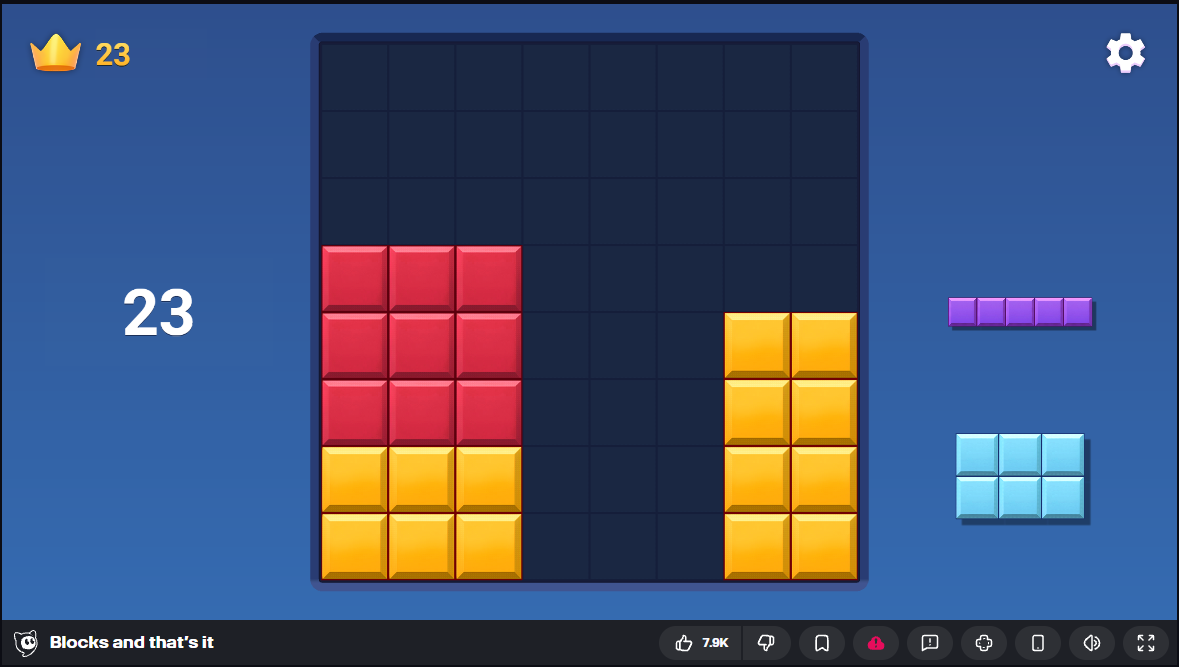
Blocks and That’s It puzzle board with red, yellow, purple, and blue block shapes

Independent review01 / Puzzle

Clear space.
Keep options.

Blocks and That’s It turns a clean grid and a few bright shapes into a thoughtful exercise in placement. The rules feel immediate; the interesting part is deciding what your board should look like after the next move.

GenreBlock puzzle
ControlsPointer / touch
Play onDesktop + mobile
Review moodClean and considered

01 — Verdict

A compact puzzle with room for real strategy.

The board is easy to read and the interaction is direct. What keeps the experience interesting is the tension between using space now and preserving useful space for the next shapes.

The short version

Every good placement solves one problem without creating two more.

Complete lines to open the grid, but resist the urge to force an immediate clear at the expense of board shape. The most satisfying sessions develop a rhythm: inspect, place, clear, and reorganize.

01

What stands out

Strong contrast and chunky pieces make the board state legible in an instant.

02

Where depth appears

Open lanes, awkward gaps, and the order of your placements make each turn a spatial problem.

03

Who will enjoy it

Players who like relaxed controls, visual logic, and improving through better board management.

02 — How it plays

Read the board before you touch it.

Interaction is deliberately simple, so attention stays on the puzzle. Use the pointer or a touch gesture to place the available shapes and work toward complete lines.

01

Survey

Check the full board and every available shape. Large or inflexible pieces should influence the plan.

02

Place

Choose a position that advances a clear while keeping broad, connected areas open.

03

Clear

Complete a full line to remove it and create new placement routes across the grid.

04

Reset

Reassess after every change. A board that looked crowded can become flexible again.

Try the puzzle on CrazyGames ↗

03 — Design analysis

Why the simplicity works.

The game removes almost every distraction between decision and result. That makes the quality of the board state—not the complexity of the interface—the main source of tension.

A

Immediate visual language

The dark grid and bright pieces separate occupied and open space clearly. You can understand the current puzzle without searching through extra interface elements.

B

Short feedback loop

Placement produces an instant result. When a line clears, the reward is visual clarity and a more useful board.

C

Self-directed pace

The experience rewards looking before moving. It works equally well as a quick reset or a longer session focused on improving decisions.

04 — Practical tips

Protect the shape of your empty space.

Empty cells are only useful when future pieces can reach them. These habits help turn scattered room into usable room.

01

Keep a wide landing zone

Reserve at least one broad open area so a larger shape does not trap the board.

02

Build parallel lines

Advancing more than one row or column gives a later piece multiple ways to produce a clear.

03

Avoid single-cell pockets

Tiny enclosed gaps are hard to use. Favor smooth edges and connected open space.

04

Place in the right order

The same shapes can create very different outcomes depending on which one reaches the grid first.

05

Use edges with intention

Edges can organize a build, but packing them too tightly may leave the center difficult to repair.

06

Re-read after a clear

A removal changes the whole puzzle. Pause and find the new best route instead of following the old plan automatically.

Final take

Minimal rules.
Meaningful choices.

Blocks and That’s It is strongest when you want a puzzle that explains itself through play. Its clean visual design, uncomplicated controls, and constantly changing board create an inviting loop with enough strategy to reward patience.

Our recommendation: open it when you want a readable, low-friction spatial challenge and the satisfaction of turning a crowded grid into an orderly one.

Play Blocks and That’s It ↗